

SCANOLOGY has just introduced NimbleTrack Gen2. With upgraded technology, SCANOLOGY's NimbleTrack Gen2 is capable of scanning large and complex areas significantly faster, while maintaining measurement-level accuracy. This is the next generation of the company's mobile optical tracking and 3D scanning systems. SCANOLOGY's NimbleTrack Gen2 is designed to deliver higher performance, especially in speed and measurement range.

A breakthrough opportunity for R&D processes awaits the Vietnamese engineering community. The specialized workshop "Driving Engineering Innovation Through Smart Simulation" organized by ANSYS will take place on October 29, 2025, at the Innovation Hub Building, updating the latest advanced simulation solutions for the manufacturing, electronics design, and Nano-Micro industries.
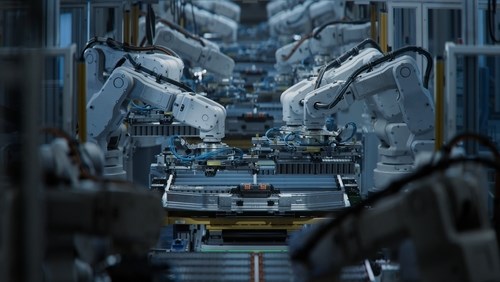
In the global race to automate manufacturing, China is emerging as a pioneer with the “dark factory” model – where robots and artificial intelligence completely replace humans. Requiring no light or rest, the new generation of factories operate continuously 24/7 with superior precision and efficiency.
A reactor that China is cooperating with Russia to build on the Moon will provide power for a settlement at the south pole in 2035.

Simulation of astronauts operating on the Moon. Photo: CNSA
China is considering building a nuclear power plant on the Moon to power the International Lunar Research Station (ILRS), a project being developed in cooperation with Russia. The plan was shared by Pei Zhaoyu, chief engineer of the Chang'e 8 mission, during a press briefing on April 23, according to Interesting Engineering.
The Chang'e 8 mission, scheduled for launch in 2028, is a key step in China's space ambitions, helping to prepare for a permanent settlement by 2030 and to explore methods of energy production on the Moon. Although nuclear power is a compelling option, Pei shared that authorities are also discussing other alternatives for the ILRS space station.
Energy is one of the biggest challenges for the ILRS station, according to Wu Weiren, chief designer of China's lunar exploration program. The ILRS will need a reliable, long-term power source to overcome the harsh conditions on the Moon. Russia's expertise in space nuclear technology will play a crucial role in the plan. In 2024, the Russian space agency Roscosmos also revealed that they aim to build a reactor on the Moon with China by 2035. This collaboration will provide the ILRS with a continuous power source and enable long-term lunar exploration missions.
China's space program has developed rapidly over the past 20 years. After becoming the third country to send a person into space in 2003 with the Shenzhou 5 mission, China landed the Chang'e 3 rover on the Moon a decade later. China was the second country to land a rover on Mars and aims to send humans to the red planet in 2033.
If the nuclear power plant on the Moon is successfully built, China could change the future of space exploration, unlocking the potential for large-scale energy production and cargo transportation. According to the Royal Museums Greenwich, the Moon contains valuable deposits of metal oxides, titanium, rare earths, and aluminum. Notably, the rare isotope helium-3 could solve humanity's energy needs for about 10,000 years.
An Khang (According to Interesting Engineering)

(84) 896 555 247
 Tiếng Việt
 English