
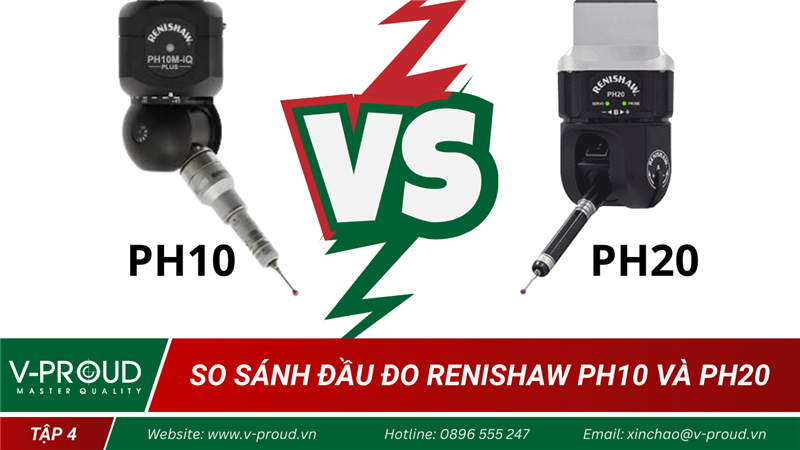
Using older 3D CMM measuring machines is a temporary solution to save costs and address measurement and quality control issues in small and medium-sized enterprises with limited capital. Therefore, Renishaw has researched and launched measuring head systems that significantly upgrade and improve measurement capabilities using only PH10 and PH20 measuring heads.
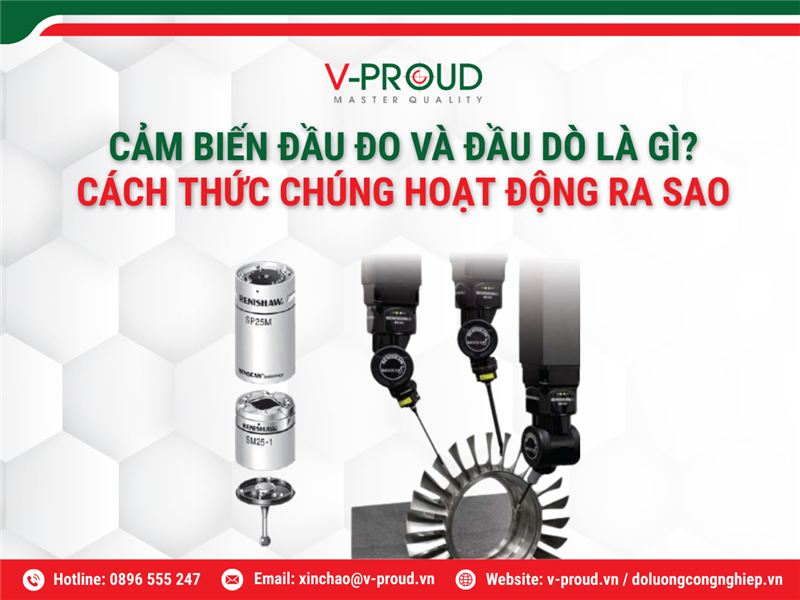
Renishaw probes and sensors are the core foundation in coordinate measurement (CMM) and machine tool measurement (CNC) technology. These devices act as the first link directly connecting to the workpiece, allowing the machine to collect X, Y, and Z coordinate data to calculate the dimensions, shape, and position of geometric features.
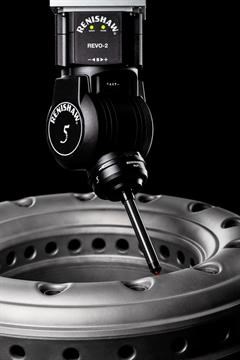
The RUP1 (Ultrasonic Probe) module is one of the most unique accessories of the Renishaw REVO 5-axis system. It allows the CMM to perform material thickness measurements using ultrasonic waves. With the Renishaw REVO 5-axis RUP1, you can measure the thickness of walls without needing to approach from both sides. This is an extremely useful solution for the aerospace industry, where the Renishaw REVO 5-axis is used to inspect hollow turbine blades.
Renishaw probes and sensors are the core foundation in coordinate measurement (CMM) and machine tool measurement (CNC) technology. These devices act as the first link directly connecting to the workpiece, allowing the machine to collect X, Y, and Z coordinate data to calculate the dimensions, shape, and position of geometric features.
1. Kinematic Resistive Touch Sensor Technology
.png)
This is the most traditional, durable, and common technology (e.g., TP2, TP20, TP6 series).
Mechanical principle (Kinematic location): Inside the probe is a mechanism consisting of three support bars, each resting on two ball bearings, creating a total of six precise mechanical contact points. A compression spring keeps the probe in a stable (seated) position.
Electronic activation principle: An electrical circuit runs through these six contact points. When the probe touches the workpiece, the contact force begins to balance with the spring force, reducing the pressure at the contact points. The circuit's resistance increases until it exceeds the set threshold, at which point the probe sends an activation signal to record the coordinates.
Technical characteristics: Due to the geometric structure of the three support bars, the activation force will not be uniform in all directions, leading to "lobing" (petal-shaped error). However, this technology is very robust, compact, and low-cost.
2. Strain-gauge technology
.png)
Silicon crystal sensor principle: Instead of using resistance circuits through mechanical contact points, this technology uses four strain gauges mounted on internal baffles within the probe body.
High accuracy: These sensors are extremely sensitive, capable of measuring very small contact forces transmitted from the stylus before the mechanical mechanism is lifted from its stable position. This eliminates most "lobing," allowing the use of longer styluses (up to 180mm) while maintaining extremely high repeatability (0.35µm).
Lifespan: As a solid-state component, the strain gauge has a very long operating lifespan, exceeding 10 million activations.
3. The role of the stylus and calibration
No matter how advanced the sensor is, the ultimate accuracy still depends on the stylus.
Ball Roundness (Grade): Renishaw uses only Grade 3 (0.08 µm deviation) and Grade 5 balls to ensure perfect tip shape.
Needle Body Material: The needle body must have extremely high rigidity (such as Tungsten Carbide or Carbon Fiber) to prevent bending (deflection) that causes errors upon contact.
Calibration Procedure: Before measurement, each measuring head must be calibrated on a standard ball of known size to determine the effective working diameter and the center position of the measuring needle in the machine's coordinate system.
Conclusion: Renishaw's operating principle is a sophisticated combination of precise mechanics, sensitive electronics, and modern motion control algorithms, enabling businesses to absolutely control their production processes.

(84) 896 555 247
 Tiếng Việt
 English